Master IELTS Writing Part-2 in 2026 with this Band 8+ Strategy Guide
|
VAKSARA.COM IELTS Academic Writing Band 8+ Strategy 2026 Edition
| Task 1 & Task 2 |
International Standards |
Meta Title: IELTS Academic Writing Band 8+ Strategy (2026
Guide) |
vaksara.com
Introduction: Why Most Candidates Get Stuck at Band 6–7
Every year, thousands of
IELTS candidates sit the Academic Writing test with strong English skills,
months of preparation, and genuine motivation — and still walk away with a Band
6 or 6.5. It is one of the most frustrating experiences in language testing,
because the gap between Band 6 and Band 8 is rarely about knowledge. It is
about execution.
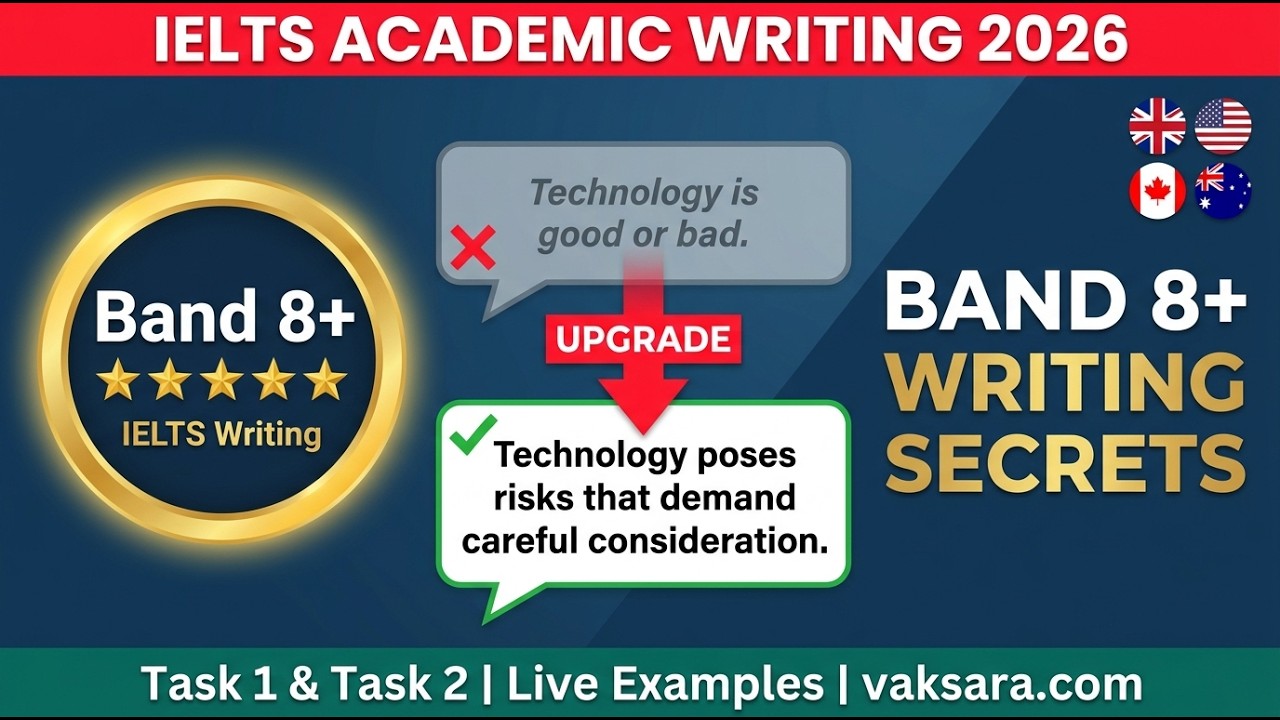
Watch You tube: https://youtu.be/fyWwPzFuJQc
The truth that experienced
IELTS educators know well is this: most candidates underperform not because
they cannot write in English, but because they do not write in the way that
IELTS examiners are trained to reward. They use vocabulary that is correct but
imprecise. They construct paragraphs that address the question but lack logical
depth. They connect their ideas with linking words that are technically
accurate but mechanically overused. The result is writing that reads as
competent but not confident — and that distinction costs them at least one full
band.
In 2026, IELTS Academic Writing continues to be assessed on four equally weighted criteria: Task Achievement, Coherence and Cohesion, Lexical Resource, and Grammatical Range and Accuracy. To score Band 8 or above, a candidate must demonstrate control across all four simultaneously — not just in isolated sentences, but consistently across an entire response. This guide will show you exactly how to achieve that, with strategies, model language, and before-and-after comparisons drawn from current examiner expectations.
Understanding IELTS Academic Writing: The Two Tasks
Before strategies can be applied effectively, it is essential to understand precisely what each task demands — not in general terms, but at the level of detail that separates a Band 7 response from a Band 8 one.
Task 1: Academic Report Writing
Task 1 requires candidates to describe and interpret visual data — a graph, chart, table, map, or process diagram — in a minimum of 150 words. The word 'describe' is important here, but it is only part of the picture. At Band 8, candidates do not merely list data points. They identify the most significant trends, group related information intelligently, make meaningful comparisons, and present an overview that captures the overall message of the visual. The overview is the single most important element in Task 1: without it, no response can exceed Band 6, regardless of how accurate or detailed the rest of the writing is.
Task 2: Academic Essay Writing
Task 2 carries twice the
weighting of Task 1 in the final writing score and requires candidates to
produce a minimum of 250 words in response to a question or statement. The
essay types encountered in 2026 include opinion essays, discussion essays,
problem-solution essays, and advantages-disadvantages essays. Each type demands
a slightly different structural approach, but all require the same underlying
qualities: a clear and consistent position, well-developed arguments supported
by specific examples, and a conclusion that consolidates rather than merely
repeats.
|
Key Principle for Both Tasks At Band 8+, every sentence must serve a function. There is no room
for padding, repetition, or vague generalisations. Every word earns its
place. |
Band 6 vs Band 8+: What the Examiner Actually Sees
Understanding the
difference between Band 6 and Band 8 at the criterion level is one of the
fastest ways to improve your score, because it tells you exactly what to
change. The table below maps the four criteria to what a trained examiner
observes at each level.
|
Criteria |
Band 6 |
Band 8+ |
|
Task Response |
Addresses topic but lacks depth or clear position |
Fully addresses all parts with a well-developed, consistent
position |
|
Coherence |
Basic linking words; occasional illogical sequencing |
Smooth, logical flow; cohesive devices used naturally and
precisely |
|
Vocabulary |
Repetitive, simple words; limited collocation awareness |
Flexible, precise, context-appropriate vocabulary; natural
collocations |
|
Grammar |
Frequent errors in complex structures; limited sentence
variety |
Mostly error-free; wide range of sentence structures used with
control |
|
The Core Insight Band 8 is not about using longer words or more complex grammar. It is
about clarity, control, and the ability to communicate with precision and
confidence — consistently, across every paragraph. |
Five Proven Strategies to Reach Band 8+
|
1 |
Master the Introduction for Task 2 The
introduction is the examiner's first impression of your writing, and it sets
the tone for your entire band score. A Band 8 introduction does two things
precisely: it paraphrases the question using genuinely different language —
not simply rearranged synonyms — and it states a clear, specific position
that will be maintained throughout the essay. Vague or hedged openings, such
as 'There are many opinions about this topic,' immediately signal a Band 6
response. A strong Band 8 introduction commits to a viewpoint and frames the
argument that follows. |
|
Band 6 — Before |
Band 8 — After |
|
Many people think technology is good or bad. This essay will
discuss both sides. |
While technology has fundamentally transformed modern life in
countless beneficial ways, a growing body of evidence suggests that its
unchecked use poses significant social and psychological risks that demand
careful consideration. |
|
2 |
Build Paragraphs with Topic Sentence → Evidence → Analysis Every
body paragraph in a Band 8 essay follows a three-part architecture: a topic
sentence that states the paragraph's central claim, specific evidence or an
example that supports that claim, and an analytical sentence that explains
the significance of the evidence. This structure — sometimes called the TEA
or PEE model — ensures that every paragraph is both logically coherent and
fully developed. The most common Band 6 error is omitting the analysis:
candidates state a point and provide an example, then move on without
explaining why the example supports their argument. That missing analysis is
precisely what separates a developed response from an underdeveloped one. |
|
Model Paragraph (Band 8) One of the most significant advantages of online education is the
flexibility it affords learners. Unlike traditional classroom settings,
digital platforms allow students to access course materials at any time and
from any location, making it possible for working professionals and
caregivers to pursue qualifications without sacrificing their existing
responsibilities. This flexibility not only increases access to education but
fundamentally democratises it — removing the geographical and financial barriers
that have historically excluded large portions of the global population. |
|
3 |
Use Cohesive Devices Naturally — Not Mechanically One
of the most reliable markers of a Band 6 response is the mechanical overuse
of discourse markers: 'firstly,' 'secondly,' 'thirdly,' 'moreover,'
'furthermore,' 'in conclusion.' These words are not wrong, but their repeated
use in a predictable sequence signals to the examiner that the candidate is
relying on a template rather than writing with genuine fluency. At Band 8,
cohesion is achieved through a combination of well-chosen linking
expressions, referencing devices such as pronouns and synonyms, and logical
paragraph sequencing that makes the argument feel natural rather than
assembled. The test of good cohesion is simple: if you removed all the
linking words, would the ideas still flow? At Band 8, they should. |
|
4 |
Upgrade Vocabulary Through Precision, Not Complexity Lexical
resource at Band 8 is not about using rare or impressive-sounding words. It
is about using the right word in the right context with complete accuracy.
Examiners are specifically trained to identify collocational errors —
combinations of words that are individually correct but unnatural together,
such as 'do a decision' instead of 'make a decision,' or 'strong opinion'
where 'firm opinion' would be more precise. The most effective vocabulary
upgrade strategy is to study words in collocations rather than in isolation,
and to practise using them in full sentences within timed writing tasks. |
|
Basic (Band 5–6) |
Band 8+ Upgrade |
Why It Works |
|
good |
beneficial
/ advantageous |
Precise; fits academic register |
|
bad |
detrimental
/ counterproductive |
Context-specific; avoids
vagueness |
|
many |
a
significant proportion of |
Quantifies accurately without
data |
|
important |
crucial /
indispensable |
Signals weight and urgency
clearly |
|
show |
demonstrate
/ illustrate |
Academic collocations;
examiner-preferred |
|
a lot of |
a
substantial number of |
Formal register; avoids
informality |
|
people
think |
it is
widely held that |
Impersonal academic framing |
|
get better |
improve
significantly |
Verb-adverb collocation; natural |
|
5 |
Achieve Grammatical Range Without Sacrificing Accuracy Grammatical
range at Band 8 means using a variety of sentence structures — simple,
compound, and complex — with consistent accuracy. The key word is
'consistent.' Many candidates produce one or two impressive complex sentences
and then make errors in the simpler ones, which undermines the overall
impression. A more reliable strategy is to ensure accuracy first across all
sentence types, then consciously introduce structural variety: relative
clauses, passive constructions, conditional forms, and noun clauses. One
well-constructed complex sentence per paragraph, combined with accurate
simpler structures throughout, is far more effective than a response peppered
with ambitious constructions that are frequently incorrect. |
|
Band 6 — Before |
Band 8 — After |
|
People is using technology every day. It make their life
easier. |
The widespread adoption of technology in everyday life has
unquestionably enhanced convenience, enabling individuals to manage complex
tasks with a degree of efficiency that was unimaginable a generation ago. |
Task 1 Deep Dive: Writing a Band 8 Overview and Report
Task 1 is frequently underestimated by candidates preparing for Band 8. Because it appears shorter and less complex than the essay, many candidates spend less time preparing for it — and pay the price in their final band score. The following principles are non-negotiable for Band 8 in Task 1.
Write a Dedicated Overview Paragraph
The overview is a concise
summary of the most significant trends or features visible in the data, written
without specific figures. It answers the question: if someone could see only
one paragraph of your response, what would they need to know? A strong overview
identifies the dominant trend, the most notable comparison, or the most
significant change — and states it clearly in two to three sentences. It is
conventionally placed after the introduction, before the detailed data
paragraphs.
|
Model Overview (Band 8+) Overall, the data reveals a consistent upward trend in online media
consumption throughout the period examined, while engagement with traditional
print media experienced a steady and marked decline. The most striking
feature is the convergence of the two trends in the final year, suggesting a
significant shift in the way audiences access information. |
Group Data Intelligently
Band 8 reports do not describe data point by data point in chronological order. They identify logical groupings — countries with similar patterns, time periods with comparable trends, categories with contrasting trajectories — and organise the body paragraphs around those groupings. This approach not only demonstrates analytical thinking but also produces writing that is naturally more coherent, because the information within each paragraph is genuinely related.
Integrate Specific Data as Evidence, Not as
Narrative
Specific figures — percentages, years, numerical values — should be used to support and illustrate the trends you describe, not to replace the description itself. A common Band 6 error is to list data points in sequence without identifying the underlying trend: 'In 2010 it was 30%, in 2015 it was 45%, in 2020 it was 62%.' A Band 8 response would write: 'The figure rose steadily from 30% in 2010 to 62% by 2020, nearly doubling over the decade.' The trend is stated, then evidenced — not replaced by raw data.
Common Mistakes That Prevent Candidates from Reaching Band 8
Understanding what to do
is only half the preparation. Equally important is understanding what to avoid.
The following are the four most frequently observed errors in responses that
score Band 6 or 7 rather than Band 8.
|
Writing in an Informal Register Academic
writing demands a consistently formal register throughout. Contractions such
as 'don't,' 'it's,' and 'can't' are unacceptable in Task 2. Colloquial
vocabulary — 'kids' instead of 'children,' 'a lot of' instead of 'a
significant amount of,' 'thing' instead of 'factor' or 'element' — signals a
lack of register control that directly affects the Lexical Resource
criterion. Every word choice should be evaluated against the question: does
this belong in a quality academic journal? If not, find a more precise
alternative. |
|
Submitting Memorised or Recycled Responses IELTS
examiners in 2026 are extensively trained to identify memorised content —
pre-learned phrases, template introductions, and recycled body paragraphs.
Not only does memorised content undermine authenticity, it frequently results
in off-topic responses that fail to address the specific question asked. The
solution is not to memorise model answers but to internalise the structural
principles behind them, so that every response is genuinely constructed in
response to the specific task on the page. |
|
Omitting the Task 1 Overview As
noted above, the absence of an overview in Task 1 prevents a response from
exceeding Band 6 under the Task Achievement criterion, regardless of the
quality of the data description that follows. This is one of the most costly
and easily avoidable errors in IELTS Academic Writing. Make the overview the
first thing you plan when reading the Task 1 prompt, before you write a
single word of your response. |
|
Prioritising Impressiveness Over Clarity The
most persistent misconception among Band 7 candidates aiming for Band 8 is
that the examiner is rewarded by long words, elaborate sentence structures,
and dense vocabulary. In fact, the opposite is closer to the truth: an
examiner reading 40 scripts in a day is most impressed by writing that is
immediately clear, logically organised, and precisely expressed. Complexity
that creates confusion always lowers a band score. Clarity that communicates
effectively always raises it. |
Mini Practice Task: Apply What You Have Learned
|
Task 2 Question Do the advantages of online learning outweigh the disadvantages? Write an introduction and one developed body paragraph. Focus on: a
clear paraphrase of the question, a specific position, a topic sentence,
concrete evidence, and an analytical conclusion to your paragraph. |
When you have written your response, evaluate it against the following four questions. First: does your introduction paraphrase the question in genuinely different language, and does it state a specific position? Second: does your body paragraph begin with a topic sentence that makes a clear, arguable claim? Third: is your evidence specific — a real example, a named context, or a concrete scenario — rather than a vague generalisation? Fourth: does your final analytical sentence explain why your evidence supports your claim, rather than simply restating it? If the answer to all four questions is yes, your response is operating at Band 8 level.
Conclusion: The Path to Band 8+ Is Clear and Achievable
Reaching Band 8 in IELTS
Academic Writing is a realistic goal for any candidate who understands what the
scoring criteria actually measure and who practises with genuine
intentionality. It is not a matter of talent, native-level English, or years of
academic study. It is a matter of applying the right principles consistently:
writing clear, well-structured responses; using precise, context-appropriate
vocabulary; achieving coherence through natural rather than mechanical means;
and maintaining grammatical control across a varied range of sentence
structures.
The strategies in this
guide — from the introduction formula to the overview paragraph, from the
vocabulary upgrade table to the paragraph architecture — are not theoretical
ideals. They are the observable characteristics of real Band 8 and Band 9
responses, distilled into actionable techniques. Apply them consistently in
your practice sessions, seek feedback on your full responses, and track your
improvement criterion by criterion rather than by overall band score alone.
That granular awareness of where your writing is strong and where it still
needs work is the fastest route to the score you are aiming for.
The examiner is not looking for perfection. They are looking for a writer who communicates with confidence, clarity, and control. That writer can be you.
Quick Revision Checklist — Before You Submit
|
✓ |
Task 1: Have you written a
dedicated overview paragraph? |
|
✓ |
Task 1: Is your data
grouped by trend, not listed chronologically? |
|
✓ |
Task 2: Does your
introduction state a specific, clear position? |
|
✓ |
Task 2: Does every body
paragraph follow Topic → Evidence → Analysis? |
|
✓ |
Both tasks: Have you
avoided all contractions and informal vocabulary? |
|
✓ |
Both tasks: Are your
cohesive devices varied and natural — not mechanical? |
|
✓ |
Both tasks: Have you
checked verb agreement, articles, and tense consistency? |
|
✓ |
Both tasks: Is every
sentence clear, purposeful, and free of redundancy? |
|
Want more Band 8+ strategies? Follow vaksara.com for weekly IELTS and Business English lessons designed
for global success. |
©
vaksara.com — All rights reserved
Comments
Post a Comment